Chapter 6: "Treat Him Nicely"
[Heyoka note: It is our recommendation that readers view in tandem with the following underscore:
WARNING: This chapter contains graphic and potentially disturbing forensic reports of violence and childhood abuse. Discretion is advised.]
----------------------------------------------
Two distinct sensations of loss emerge from something misplaced versus something actively taken away. The former leaves a mnemonic impression: a warm, gummy socket your tongue keeps habitually prodding, vacant in the exact shape of what is missing. The latter leaves nothing; the technician was incentivized to excise cleanly, sparing only emptiness behind – and a professional always honors his contract.
----------------------------------------------
'…You go home, and you can still hear the monitor at night. What do you do?'
...
The monitor counts.
It ticks on in an indifferent, mechanical manner, emitting a truncated bleep at the top of each beat; a pulse, asystole – any fluctuation at all. The machine does not editorialise.
The room holds the cold of a converted subterranean space where the floor sweats in summer and the bleach in the corner sink never quite resolves the older, biological odors beneath it. The light overhead has the hazy wash of a bulb behind frosted glass, a fatigued, fluorescent hum underscoring its detachment from the surroundings. Joining the light’s droning mantra is a voice – somewhere, reciting sequences in a register too muddied to parse. Looping on a tape spliced end to end, its unrelenting procession grants no respite; a sentence crafted to carve grooves in any soft, visceral putty it falls upon.
There is a body on the table.
It wears a cotton gown that does not belong to it, institutional and yellowed at the collar. The cuffed wrists rest at its sides. A firm, leather strap crosses the chest at the level of the second rib and another at the iliac crests. It knows the chilling, conductive scent of Ten20 paste and the stale, rubbery spit of something tightly wedged behind the back molars to save its quivering tongue from the inevitable clamping.
A pair of hands work below the machinery’s count, gloved and gliding somewhere peripheral with a profane tactlessness. The hands belong to a man whose breath carries the carbolic over-sweetness of a peppermint chewed to mask something more sour and animal. The hands check, with the brisk efficiency of transactions made with this body before, the bilateral contact of electrodes to its temples.
The body on the table is fifteen-years-old.
It watches the man, wide-eyed and silent, as a child watches an imminent storm it cannot retreat indoors from. The man’s face drips and melts into something with mandibles, something glistening and segmented from which smaller scurrying masses scatter and feed.
The spoken lathe begins to scour the surface in incrementally tight loops, and a boy does the only thing he has been left with: he opens his mouth around the bite-block and he sings -- loud, threadbare -- a song from a year none of them remember, because that song is the one room they have not pried the locks from. He holds the first phrase the way a drowning target holds a harpoon in its skull.
Muffled through dense wool, the man coos something almost gentle about cleanliness: “Hold on now, partner. We'll brighten you up.”. He twists the dial through each steady, affirmative notch, and flicks the switch. The white-hot ozone crashes down like a hammer on a struck bell, annihilating the body’s final, melodic refrain in a tonic-clonic dance of convulsing masseter and diaphragm—
...
"—Sonny."
The microwave is beeping.
It has been beeping for a while. The blinking digital display reads out 00:00, patient as a metronome, and the bowl inside has gone from hot to warm to the temperature of a held breath while he sat here, eyes fixed upon nothing.
Sonny. Hey."
He blinks. Denise is across the table in her periwinkle sweater, sketchpad pushed aside, watching him with the same undetectable steadiness she has spent years learning to apply. She has been talking to him. He can tell because the sentence she was just finishing had the cadence of something that began far earlier into the Saturday morning he cannot currently reconstruct.
"There he is," she says softly, getting up to silence the microwave before it insists again. “You went somewhere. Where did you go?”
"Oh, just woolgathering. You know me." he replies nonchalantly.
Denise sets the bowl in front of him again with a spoon beside it laid parallel to the edge. Congee, he understands after a moment, the rice cooked down past the point of being rice into a substrate one can be coaxed to accept, even one who has forgotten how to want food. There is a swirl of sesame on the surface and a few threads of scallion she has cut very fine. She has been up cooking a dish that requires two hours preparation on a weekend prior to starting her own day.
"Eat what you can," she prompts. "It's not a test."
Sonny grasps the spoon, which is the price of this sentence. She lets him pay it, looking away to grant him privacy. He could say something chipper. He could ask her whether the wing-like feathered sleeves he rooted for made the cut with her last garment, but he allows the performance to idle.
"Anyway, I was telling you about the dryer." She resumes, mild.
"The dryer?" He asks, carefully edging his spoon around the perimeter of the bowl.
"Belt's gone. Chester says it's a forty-minute fix but he's booked at the rec center later today."
"Chester contains multitudes."
"At the very least, he contains a drill and a grudge against that center's wiring." She pauses to sip her Oolong tea. "Did you sleep."
"Like a sock in a drawer!” He grins.
"That's not a yes." Denise shoots him a knowing glance.
"It's a textile metaphor. Those are legally binding." Sonny takes in a heaped spoon of her Congee as a fair sacrifice for his quip.
Denise offers the smallest exhale through her nose, a near-laugh she rations for him when she has decided to credit the measurable efforts she knows he exerts when operating at baseline. She can sense the shift. With Tuesday’s depot bidding its final thawing departure, the Fire is back with polished receivers. The footage runs at full wattage. Indeed, the basement that just held him was not pure memory -- It was a transmission. The Fire, restored to its ambient crackle, retains a great deal of footage and exercises no judgment about its scheduling.
“There is one other thing I wanted to mention, now that you’re doing a little better.” She places her words cautiously, examining a single green leaf as it drifts across the surface of her drink.
Sonny continues his slow, deliberate intake of her cooking as he watches her attentively, greenlighting her inquiry.
"You didn't wake me."
He sets the spoon down.
"You said you would," she reminds him. Not sharp, but rather lowered like a weighty object carried so far your arms have grown numb, a point where relief and grief are indistinguishable. "If it got worse. You looked right at me and said you’d wake me, and then you went up, closed your door, and I found the medicine on your desk in the morning where you’d left it for me to find. Which was kind – it really was. You wanted me to know, but only after it was all over." Her thumb smooths maternally along the spine of her sketchbook the way you'd soothe a wounded animal, "I'd rather have been awake before, to help."
Sonny’s voice emerges more low and regimented than his usual patter, the words arriving sequentially. "I didn’t want to s-spend you.” There is a live-wire tension under the measurement. "You're not… A thing I get to spend, Dee. You had the buyer, and the Edison run and a whole life that isn't this; isn't me.” He enumerates each point with his fingers as if counting nails in his own coffin. “I sat on my bed that night and my arithmetic said: don't wake her up to watch you do a thing she can't change anyway. Just let her sleep. Spend the ampoule, not the friend. Does that make sense?" A sudden, acute desperation creases his expression before he actively corrects it. “I mean, I—” He rotates the spoon a quarter-turn against the table, checking it for asymmetries it does not have. "Turns out it was the wrong arithmetic. I'm sorry – I do that. I run the numbers wrong on purpose, so the answer comes out kinder for everybody except the one I'm actually deciding about."
Denise looks at him then, and he registers something splintering in the undercurrent of their friendship: a love that has begun, somewhere down in its foundations, to be afraid for him. Subliminally, underneath that, there is a pick in the ice: a decision. He feels it stab her unconscious mind before she swats it away, ashamed, and he loves her so very much in that instant that the wet sand in his head clears and the Fire flares once.
The walls around Denise dampen to gauze and the suggestion of a stage assembles: boards underfoot, a proscenium's dark arch overhead, and high above lies a rig of lamps. A select few lamps are lit and trained down on her. It is a bright, burning light that flatters from a distance but interrogates up close. She has spent her life standing in that spotlight and smiling into the empty ranks. Around the edges, a thin smoke is billowing out from the wings: the sort machines make, scentless and theatrical, except now it is creeping out across the boards toward her ankles, caught by the blooming lamps, possessing the faint filament shiver of a circuit pushed beyond its safety rating.
"Please eat three more spoons," she says to the audience flatly, as the bubbling flesh around her hollow eyes begins to slough away and singe, "And then I’ll stop hovering."
The kitchen returns. Denise’s hand rests gently upon his shoulder, looking at him with a familiar, crestfallen compassion behind her smile. Sonny eats; it is good. He tells her so, and the chipper-performance finally catches, weakly. A pilot light replaces the blaze, and she accepts it for what it is.
----------------------------------------------
Chester, whose socially-averse schedule has him working weekends, enters through the side door at 10:20 AM, between his panel job and the rec center. He brings with him a waft of cut conduit and the cigarette he thinks nobody clocks behind the mint he ate after. He is mid-anecdote before the door shuts, because Chester narrates his arrivals the blasé way others whistle: to announce normalcy.
"…So the super, right, he swears blind there's no junction in that wall, swears on his mother. I open it up, and -- plain as the nose on his face, there it is: unboxed... From -- I wanna say -- the Carter administration." He sets his lunch cooler on the counter and clocks Sonny at the table and the bowl in front of him, and something behind his eyes does a quick, kindly arithmetic of its own and mellows. "Hey, brother.” He then turns to Denise. “Look at this guy, vertical and everything."
"Hey, Ches!" Sonny perks up.
"You want a sandwich? I'm making a sandwich; gotta dash soon. I've got the good capicola, the stuff I labelled, which means it's mine – so you can have some, too." He is already at the fridge, already grappling at the jar of hot peppers. “You want one, Dennie?", he asks Denise in the same, swift motion. Motion is Chester’s vehicle for love.
"I'm okay."
"She's always ‘okay,’" Chester husks to Sonny conspiratorially, before he recognizes the silhouette of his own sentence land too close to forbidden territory, rerouting around it with same deftness he routes wires. "How you feeling, bud. You good?"
001 0472913 8602454 001U 008C 004Z
"I'm all aces!" Sonny says. "Slept like a felled tree. Dee made congee. I'm being supervised, which, frankly, I reckon I oughta be at all times, I'm a menace unsupervised, ask anyone." The patter limps but secures its threshold. "How's the Carter junction?"
“Bagged and tagged. Crimes against electricity like that number make my head spin.” Chester constructs his sandwich. He has a talent for sandwich assembly: there is a tomato involved, and a precision to the layering that suggests he might have been an engineer in a luckier draw of the cards. The sight pushes another candid reading up through the Fire, unbidden, against the inside of Sonny’s eyes.
The kitchen goes gauzy once more, this time holding for the drawling duration of Chester’s clear resonance. Chester’s signal has always held the amplitude of a man without subtext, who has decided – as his life’s project – to prevent subtext from ever becoming necessary.
It is a factory.
Tidy, modern, well-ventilated – the good kind: one with its regulatory accreditations framed plainly. Rows of long conveyers run the length of the floor and, on each line, a product ferries in. Identical units in identical order. At fixed intervals along the belt, the imposing presses procedurally descend to hydraulically compress them into the specified form. There is neither malice nor relish in this act, this is simply the shape of Chester’s survival mechanism: you take the problem, lower the press, make it the right size to fit the day’s mould, and you move it along. You do not vacillate about the qualities of the raw material because looking too long causes a man’s hands to shake at the line. A shaking man gets hurt.
There is a unit on the procession this morning that the presses constantly approach and decline to crush. Sonny knows what the unit is. He’s eating its congee.
“I’m gonna take Dee’s radio up and look at it,” Sonny announces, rising from the chair. He needs to be out of the factory before it shows him the special press it has reserved. “There’s a... The band-switch is gummy. I never finished it right.”
“There’s nothing wrong with the radio,” Denise sighs semi-inquisitively without raising her head.
“There’s always something a lil’ wrong with everything.” Sonny says briskly -- which is the truest thing he says all morning – and clutches the little set from the counter by the window, its housing still warm from the sun. He cradles it upstairs with the considerate, two-handed reverence of a man carrying something sleeping, gradually fading from the radius of Chester designating a plate of capicola with his name on it, signing off to the room: “I’ll leave you a note—“.
Sonny ascends, and the voices recede into the house’s atmospheric murmur. In his room, he nestles the dormant radio onto his desk and sits without turning on the lamp.
He listens; not with his ears – with the other thing. The thaw is well underway now, the Fire rallying in pins like a slept-on arm, spreading with uncomfortable systemic sparks.
033 0472913 009Q 110-M 004G 464-C 002A# 006X 007P 002M 033
033 0472913 009Q 001K 003C 005E 033
Through the flooring and ductwork that permeate a house’s confidences, Denise and Chester have begun to talk about him. Their words arrive thinned to bone, a jagged phrase surfacing in sudden spars, but he does not need the words. He has the rooms in which they are spoken.
Chester’s assembly line is revolving faster than usual. The presses slam with a clip, thock, release, whirr – rhythmic with backlogged feelings Chester can only process through the machinery at his disposal, pulverizing them into units small enough to be said. Sonny sees the shapes in the material right before each hydraulic crush: Tuesday night – compressed; the bruises on the neck Denise iced – compressed; the needle – compressed; the four years nobody in this house mentions – compressed. Each one filed down to a neat, manageable cube and packaged for sale. Chester is laying the cubes out for Denise the way he defines an appraisal for a client, itemizing the faults. Together, those faults constructs a conclusion Sonny has been waiting years to hear someone finally have the courage to build.
“...Not saying he’s not... I love the guy, too, babe – you know I... That’s not...”
Thock... Release...
“It’s about you. You’re up at five in the... you moved all the... I saw the... when’s the last time you slept a... I’m not allowed to be scared for you?”
Clang. Crunch. Release...
Denise’s lamps are full up now, all of them; the whole rig is blitzing down white and merciless on a single woman at center stage, rendering her at the seams. She is trying – performing the most demanding role in her repertoire: the person who is ‘fine’, who made a choice and would choose it again, but the spotlights do not relent. A fleshy bead forms at the apex of the bone and slides, fat and slow, leaving a glistering runnel down to the jaw hanging soft at the hinge. The clean line of it sags like a candle’s shoulder an hour into the wick. The smoke is no longer in the wings but choking the entire theatre, rolling across the boards in a tide up past her knees, and she is acting through it, hitting her marks in a fog she can’t acknowledge amid the heat. A thread of her hairline has begun to lift and coil, browning at the edge like film held to a match: a mixture of seeping, sizzling tears amid blackened soot. High above her, the hottest lamp has begun to sound the withering, ticking threat of catastrophic failure.
Chester lowers the press one final time on the largest unit, the one he’s been circling all morning and could not bring himself to crush, until now:
“...I just think we... Out loud, once. That maybe... maybe it isn’t safe. For him or for us. That maybe the kindest thing... I don’t know what the kindest thing is, honey, I’m not the right guy to fix this. And I’m watching it take you apart one... and I don’t... I think he might need more than we... That’s all. I think he might need not to be here.”
Thock, shatter, crush release...
“...His home, Chester. This is his home. You don’t get to... Where’s he going to... seen what those places... was his conservator, I signed the… I am not putting him back in...” Her voice cracks as it reaches him and the fire tears it asunder, the latex of her lips peeling back from the veneers in a long, reluctant strip; the painted smile she has worn so long it fused to the substrate now delaminating under the glare, and beneath that, there is only the pale, tacky underlayer of a thing built to be glanced at and not to last. A lamp blows: a soundless flare and then a dead socket where the star had shone, yet she keeps acting. She keeps standing in the slightly diminished rapture with the smoke to her shoulders melding with the fumes from her liquefying scaffold, one disintegrating cheekbone dripping toward her knees. The show cannot stop. That is its ultimate tragedy.
Up in the unlit room, Sonny sits very still in a different kind of darkness, one he knows he has been approaching all along. There is no anger anywhere in his infrastructure. The Fire hands him the truth with both its terrible palms open: Chester is right. The factory is not cruel. A defective unit will not fit through the door of their lives and a man who loves a woman is trying to keep that door from breaking off its hinges. Denise will fight for him, will keep blowing lamps on his behalf until the whole theatre goes dark and there’s nothing left to illuminate. Just a degraded soundtrack, performing in a black house to an audience of one frightened man and the felt-tongued ghost in the spare room.
001 005B 008U 001F 007Q 003C 001
“Yeah,” Sonny whispers to the dark, to the radio. “Yeah, I hear you, Chester.”
It is said without rancour, thanking the professional for his apt diagnosis. Then he reaches into the desk drawer for the soldering iron. A determined, defined means to make himself one degree less dangerous on his way out the door.
The iron takes three minutes to reach temperature, during which he unfastens the four little screws of the back panel and places them into a saucer.
The housing comes away. His previous solder work still bright like fresh enamel where he replaced the failing caps, solely because a buzzing tweeter is an unkindness he could not abide leaving in a thing Denise seeks refuge with. And there, off the board’s far corner, the carrier-wave position. An orphan band that he wired back into the circuit’s lineage by compulsion to restore what the manufacturer had abandoned.
He holds the hot iron to the first joint. The solder goes liquid with a gleaming mercury shimmer, the rosin smoke twirling up in gray and acrid ribbons, catching at the back of his throat. In that smoke, a child emerges.
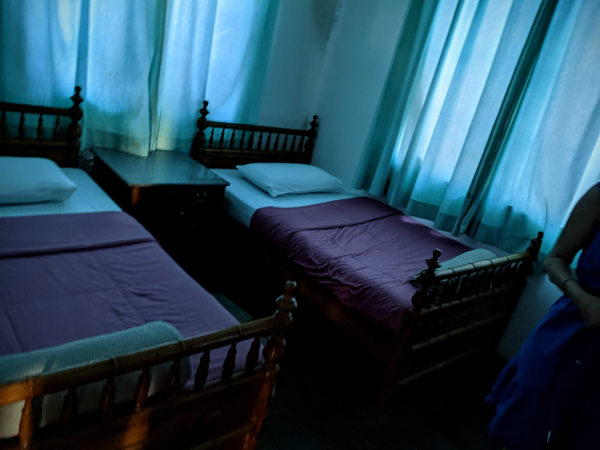
There is a submerged room with two narrow beds. A window is covered by waving pleats of mottled aquamarine blinds, enshrouding the sparse furnishing sin a deep, aquatic blue. There is a boy three years older lying very still on the far bed, awake. He is always awake. Sonny understands across the distance of nineteen years and through the rising smolders what he lacked words for then: that the older one stayed awake on purpose, on a watch nobody assigned him. When the footsteps approached the corridor in those precarious, fragile portions of the night, the older boy would be already sitting up, swinging his feet to the cold floor, placing his own small body between the door and where the younger, more wanted one lay pretending with all his might to be asleep. Because they came for the wanted one. The love for the other had curdled off the moment a better match arrived, which the older boy used as an opportunity to make himself the obstacle.
The second joint comes away in trembling, melting metal.
And then another night sonny has kept anchored in the rotten depths of his conscience with the heaviest stones he owns. He had come back to the room to find the older boy laying on the floor between their beds. There was something unnatural to the way he slumped against the nightstand. He was drawing deep, shuddering inhalations; legs bent out at angles they did not choose, a dark stain spreading slow into the cheap weave of the rug from between them. The older boy’s hands rest palm-up, fingers twitching, open in his own lap as though he had been granted something and was awaiting instructions for what to do with it.
Bleeding, unable to stand: ravaged in some manner that sent small Sonny rushing to sooth him in a futile, helpless struggle. And the face held nothing. No pain. No fear. No appeal. The older boy glazed over at the tiny, frantic Sonny crouching beside him, wearing an expression the way Kitty wears its mask: unoccupied. He had retreated to a place built precisely so no-one else could reach it, and the price of that place was all that would otherwise leak through his eyes.
He let them take it, so that they would take less of Sonny.
Sonny had embraced him then, and sung to him the same 1963 single: the only medicine he could offer. The older boy did not sing back. He had sacrificed the part of himself that could sing a long time ago.
The final joint releases. The orphan part eases free of the board on Sonny’s tweezers, a crippled, dead thing trailing two contorted legs.
He remains in the dark with the gutted radio vivisected before him, knowing he has just done to the one person who ever stood between him and that door exactly what he is about to do to Denise and Chester. The same thing he does to everyone in the end, and what – perhaps – he was built to do. He will make them safe by removing himself from the circuit. Just as he had defended this morning, he hopes his arithmetic is kind, even if calculations run awry.
He drops the tweezers with a delicate clatter, wincing and gnawing into the white knuckles of his left fist. “I’m sorry,” Sonny whimpers through his teeth to the lifeless component, before composing himself and snugly restoring the screws. He wipes his face on the heel of his glove, and drifts downstairs to return the radio to its place by the window. He will tell Denise it is all fixed now; good as new. This is a lie, yet also – in a language he holds to protect those he loves – the required truth.
----------------------------------------------
The diner on Friday night could not hold all that Amelia had brought to it.
She had watched the cog in her mobile browser grind against the frigid blue of the web-document reader and began to recognize how the network she was on was comprised of numerous people’s machines. Strangers, wedged between her and the thing she desires, each one peeling off a layer of her request and leaving it wearing so many coats that it forgets its own address. She knew it would be slow, but she did not know it would feel like this, like pressing her ear to a wall and bracing for a sound she is not sure she wants to arrive.
With lofty aspirations, she hoped the most complete record would reside in the latest folder, tapping the one marked ‘2024’ first. Instead, she butt against belligerent digital brick-wall after brick-wall. Her obsolete iPhone could not tame the Gordian knot that her more computationally competent anonymous messenger had imparted with only the most nebulous directions.
Amelia closed the browser. She had paid in cash, because her hands were not steady enough to be around a card reader and a watchful server, and she had driven home. She did not continue her investigation that night. Rather, she snatched four shambolic hours of sleep upon her couch in front of her untouched Lego disarray.
Saturday morning, she rose and valiantly braved the kitchen table with the laptop, whose screen real estate might better accommodate what this is destined to be. The kitchen table is where she was taught, by a mother who ran a household like a ward, that difficult things were to be faced sitting upright, feet firmly planted.
After logging in once more, Amelia opens the folder marked 1994 because her hand is faster than her sense, and the latency punishes her for it. The folder hangs open on nothing as minutes flow like treacle. Eventually, its contents drip down the page in bands, like a developing photograph deciding what to painstakingly show her. Filenames containing Federal offices, locations, case IDs and a word that currently holds no meaning to her: TABERAH.
She finds letters and dates, dates and letters, the alphabet sanded down to its initials to better constrict the children therein to budgetary margins. She does not let herself open them. Some instinct informs her that the worst way to do this is to start at the beginning, that beginnings are where you grieve last. So, Amelia does what she has spent her whole life doing: look for the one familiar thing in a room full of strangers and walk toward it.
She explores each folder systematically at the rate Tor permits, without unfolding its contents… The wheel turns… It snags in 2006, on the words ‘SALVATORE VOLERO’. The name does not appear in any prior year chronicling the gradual fashioning of a tiny person into a tool. It surfaces here, the year that tool turned eighteen. The year the State of New Jersey first wrote his given name onto a page and has since fought tirelessly to redact. She is about to read the day the world learned of his existence.
2006 contains four documents, which she ingests in the order they load.
The first is a newspaper clipping...
Toms River Attorney Dead; Suspect Undergoing Evaluation
A Toms River attorney was found dead in his home this week.
The victim, identified as William Maris, 54, maintained a small general practice and was known locally for representing indigent clients pro bono. A spokesman for the Prosecutor’s Office said the death involved “evidence of deliberate violence not consistent with a burglary or a domestic altercation,” and declined to elaborate, citing the active status of the matter.
The suspect, 18, whose name is being withheld, was located inside the residence by responding officers and was, in the words of the spokesman, “in a state requiring specialist evaluation” at the time of his apprehension. He has been remanded for psychiatric assessment and a determination as to his fitness to face the charges contemplated.
Maris’s sister, reached at her home in Lakewood, declined a lengthy interview but offered the following statement: “He was a careful man. He was working on something important. I do not know who would do this to him, or why.”
Amelia reads the sister's statement over. She is good at the dead. It is a strange professional pride: to be good at the moment when a life becomes a body she has to do something practical with. She does not flinch the way other techs do, able to withstand the heaviness of it and keep her hands focused yet kind. Regardless, something amid the ramifications of Maris’ ‘important work’ drops the floor of her stomach by a few centimeters.
She readies herself for the next file, the one bearing the siren nameplate which called her here:
‘SUPERIOR COURT OF NEW JERSEY | OCEAN COUNTY CRIMINAL DIVISION – CASE NO. 06-CR-2284: STATE OF NEW JERSEY v. SALVATORE VOLERO
ORDER REFERRING DEFENDANT FOR COMPETENCY AND DIAGNOSTIC EVALUATION’
The court speaks without burdensome sentimental fluff. She allows it to flow through her until she reaches the paragraph that says, in so many clauses, that the boy's responses to standardized interrogation were found to be inconsistent with the foundational validity assumptions of the instruments administered. No reliable measure of competency could be obtained, and further evaluation by inpatient observation was ordered in lieu thereof.
She has run assays that came back as so. You send a sample to the lab, who later calls to tell you that the numbers are impossible and describe an animal incapable of physically existing before you – but there it stands. The only honest thing on the report is the technician's note: the court had input the defendant into a machine for measuring people and it had returned an irrational reading.
The third document is one the Tor machine makes her wait for.
It is a Xerox copy dense with speckled ink, rolling in just as the root directory did. Except this time, each band is a sentence committing her through the many doors of the sprawling report at its own methodical pace; there is no scope to run ahead.
‘OCEAN COUNTY PROSECUTOR'S OFFICE – CRIME SCENE INCIDENT REPORT: EXHIBIT A’
The first band is delivered from the churning network of enshrouded strangers.
"The exterior door of the residence was found standing open with the deadbolt retracted and chain hanging freely. No indication of forced entry was observed at any point of access."
The second band crawled behind...
"The decedent was discovered in the second-floor bathroom. The decedent had been bound at the wrists and ankles with commercial packing tape and had been moved, postmortem indicators notwithstanding, from the residence master bedroom into the bathtub and placed in a seated posture, propped at the spine against the interior wall of the tub. The bathroom window faced east. At the estimated time of discovery, the morning sunlight cast across the decedent with apparently deliberate placement."
‘Sunlight’. Someone had arranged a man so that the dawn would touch him. She does not know yet whether to call that mercy or its inverse, and that very uncertainty supplied a voltage that would accompany her throughout the report.
The third band emerged…
"The abdomen of the decedent exhibited fifty (50) discrete incised wounds, individually deliberate, of consistent depth and spacing, distributed across the abdominal wall in a manner the responding examiner characterized as patterned."
‘Fifty’. She has closed an abdomen. She knows what ‘fifty’ is in terms of deliberate passes of the wrist and the lactic fatigue that stiffens a forearm after the fortieth careful stitch. It is not a rage. A rage cannot count to ‘fifty’. She presses two fingers hard against the bridge of her own nose as the next band appears...
"The decedent was absent the four canine teeth. The four teeth were recovered from the windowsill of the east-facing window, arranged linearly in conventional anatomical sequence."
The fifth band has Amelia put her coffee down so that her hand will have no business but to clench a fist.
"Examination of the recovered teeth and the corresponding alveolar sockets did not suggest avulsion but rather deliberate excision at the root by means of a single-edge razor blade, the gingival and periodontal tissue having been incised circumferentially to free the root prior to extraction. The procedure implied robust anatomical training and considerable patience."
In a dog’s mouth, the root of each canine extends along a curve far beyond its crown. What appears as simple pulling is actually the meticulous work of freeing -- cutting the soft collar that holds the root to the bone. A nervous hand will snap at the crown and turn a half-hour job into a butchery. The report is describing the human parallel. Someone took time to extract each tooth in entirety at the root and ceremonially present them, like a surgeon displaying his instruments for ease of access. She is going to be sick, but holds. After all, she is good at the dead – that means you don’t get to leave the room yet.
"The tongue of the decedent had been severed at the base and was recovered from a plastic cup positioned on the rim of the sink beside the faucet previously used to contain mouthwash.
Cause of death was attributed to exsanguination via uniform bilateral transverse incisions through the carotid arteries. The implement was identified as a kitchen knife belonging to the decedent. The knife had been briefly rinsed in the bathroom sink and returned to its slot in the block."
He went into the man’s kitchen, opened the block and chose. Amelia recollects on Sonny choosing a mug from the staffroom shelf, how he always made a point to select the chipped one, claiming that it earned its keep. She gets up then, walks to the window and looks at the parking lot. A squirrel scampered atop her fence toward an idling delivery van opposite her duplex. The morning is, by every external measure, an average November Saturday, indifferent and intact. With her pulse finally settling to a tolerable pace, she returns to her laptop.
She reads on. The report relays how the ‘suspect’ had been located by first responders on the bathroom floor, seated with his bare back against the heated towel rack. The sustained contact had raised a superficial burn across his skin to which he did not react. It describes ‘perseverated singing’, mistaken by one of the officers for a radio left running in the adjoining room. He did not acknowledge their arrival, instructions or presence at all. He was, in the words of the one who cuffed and lifted him to the patrol vehicle, ‘as compliant as an infant', offering neither resistance nor assistance; a dead weight.
The final section of the third document is a handwritten amendment, written in rushed, slanting cursive scanned faithfully enough to reveal where the pen pooled and ran dry, the examiner had written a note to self – something he deemed meaningful but had nowhere to send.
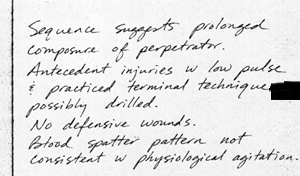 ‘Low pulse’. The heartbeat in the chest of the one who cut fifty times and freed four canine roots was at rest, stiller throughout this act than the heartrate most people achieve while asleep.
Justice is an ideal you believe in until you read it sideways in a coroner’s footnote, calling out to nobody.
The fourth document that loads is one that lacks a definitive name, labelled only with the impersonal case number. She switches to its tab:
‘PSYCHIATRIC INTAKE -- PRELIMINARY EVALUATION.
EXAMINER: LINDA BEKKERING, Psy.D.’
Here, after the uncompromised geometry of the crime, this document does the thing none of the others would: fully face the perpetrator himself. Amelia, who soldiered into this folder armored against atrocity, finds she has no armor at all for tenderness, because that is what the doctor's careful clinical prose somehow fails to suppress, a tenderness still leaking through permeable diagnostic detachment.
It opens with the structured behavioral observations from intake...
"On presentation, the subject, an 18-year-old male of slim build and apparent neurological intactness, was non-verbal in response to direct address. The subject was, however, observed to be vocalizing continuously at low volume in a manner that the intake nurse and the present examiner concur is best described as melodious singing [...]"
She knows that sound. She has heard it pour out of him when he thinks the supply closet door is shut. A rich, meandering music with its own dialects and motifs. Now she sits in the sober blue of her monitor, learning that it is not purely a happy man’s habit.
"[...] song was unfamiliar to either observer at the time of intake but later identified by a county social worker as a fragmented rendition of the c.1948 Lonnie Johnson recording 'Tomorrow Night’. The subject continued this vocalization for approximately the first forty-five minutes of intake procedures, including through the booking-photograph and the initial physical examination, ceasing only when given water, which he drank, after which he resumed vocalization in a lower register.
The subject does not respond to his legal name. The subject responds, mildly, to the diminutive "Sal." The subject does not respond at all to questions concerning the events of the preceding seventy-two hours – or any point beyond October 14th 06:54, for which period he is, in this examiner's professional opinion, organically and traumatically amnesic. The subject's affect during questioning is flat, disoriented, and free of the autonomic markers that typically betray malingered forgetting."
He does not remember. She grips that ardently like the sole source of warmth in icy desolation. However, beneath that, she still hears the lawyer's voice within her, the voice that says amnesia is not innocence; a sleepwalker does not arrive, by morning, exactly where he is wanted. She can’t settle until it is beyond reasonable doubt. She continues reading…
"The subject demonstrates substantial psychotic and dissociative pathology spanning multiple DSM-IV-TR categories and likely constituting, in this examiner's view, a complex post-traumatic phenotype with subtypes inadequately characterized in the current nosology. The presenting features include: extended periods of fugue-like activity throughout which the subject is amnesic; pressured, manic vocalizations (singing) during agitated episodes that the subject does not subsequently recall; reported and clinician-witnessed night terrors of severe intensity, with screaming, ambulation, and on one occasion during the intake observation period, an escape attempt, in which the subject opened the dormitory window and was beginning to climb out before being restrained by overnight staff; nocturnal enuresis on two of the three observed nights; psychophysiological bruxism and trichotillomania; perseverative humming during waking dissociative episodes."
And then the doctor describes the body itself. This is where Amelia's professional constitution finally fractures down the middle like a femur buckling under an oppressive force it was never graded for.
"Physical examination of the subject reveals the following findings consistent with a pattern of chronic childhood physical and sexual abuse: multiple healed scarification marks on the medial aspect of the inner thigh region suggestive of deliberate inscription rather than self-mutilation or accidental injury; multiple healed burn-pattern lesions of the small round type consistent with cigarette extinguishment, distributed across the medial surface of the upper arms and the soft tissue of the flanks; pelvic and abdominal iatrogenic scarring which, on referral to the consulting physician (Dr. K. Holloway, M.D.), was assessed as 'highly suggestive of past quasi-surgical interventions, performed with insufficient anesthesia by an anatomically-trained operator in a non-clinical setting, on a patient of pre-pubertal age at the time of the procedure’; an additional series of recently healed, fine parallel incisions on the ventral forearms which the consulting physician declined to assess but the present examiner suspects represent further ritualized inscription by a third party."
Amelia reflexively squeezes her eyes tightly shut for the duration of one long, trembling breath. The clinicians profile the boy's skin with their best approximation of deliberate disinterest: the voice a clinician uses precisely because the things it is naming would unmake a person who said them in any other tone.
‘Anatomically-trained’. Both this evaluation and the previous incident report agree on this: those same words describe both the instrument who excruciatingly freed those four roots, and the hands that -- many years prior -- opened a small child. Against all her inner protest, the two sentences meld into a noxious, nauseating concoction in her mind. Somebody taught a child the insides of a body by doing the insides of his.
She thinks of how gentle he is with the clinic cat, how even the feral one that bites everyone flops loose and stupid in his lap, how she had thought that was a gift in him, an unguarded sincereness, and how she is learning tonight that it might instead be a thing that was carved into him with a scalpel before he was old enough to spell his own name. That stillness the animals trust, the slow heart, the patient hand… She had fallen for the symptom and called it a man.
"It is the considered opinion of this examiner that the subject is presenting in a state of profound impairment which renders him not presently competent to assist in his own defense; that the subject is, in addition to being the perpetrator of the act of which he is accused, also, by every clinically detectable marker, a victim of a sustained and as-yet unidentified pattern of abuse perpetrated upon him from a developmental age. Given the aforementioned assessments, the recommended, most ethically defensible disposition of this matter is the immediate referral of the subject to a state inpatient psychiatric facility for an indefinite duration of restorative care."
This is the part that finishes her, because it refuses to file Sonny under monster. It holds him instead in the impossible superposition. That refusal engulphs every atom of her sense of justice into flames. She realizes with a sick clarity that she will have to live with this burning, because – God help her – she has never cared for anyone more than she cares for him, right now.
There remains one more band, developing by individual row of pixels at a time. Upon arrival, the text grabs her face and makes direct, unwavering eye-contact with her.
"This examiner has, accordingly, transmitted under separate cover certain observations regarding the subject's history and presentation to a colleague within the Office of the Inspector General whose investigative jurisdiction may, in the examiner's understanding, encompass the relevant matters. [...]"
An addressee is noted, blacked into a long murky lozenge of redaction the way every name in this archive has been blacked, the world protecting itself by removing the parts that could be loved. However, the lozenge thins at its ends where the coroner’s marker exhausted. Four letters surface from the darkness:
"[...] ██████████████████████WREN"
Amelia is on her feet, but she does not remember standing. The chair has toppled behind her with a flat slap against the tile floor. Her body has decided and, by the time her mind synchronizes, her thumb is already dialling the number. It rings twice. The voice that answers is not surprised, as if it has been waiting decades for her daughter to make a particular phone-call at an hour just like this. Amelia does not say hello. She drops the question that is consuming her like a poison needle in a vein.
"Mom. Did Dad ever talk about a place… In central Jersey? A foster facility – some research thing...?"
There is a frosted silence on the line with a corporeal silhouette.
"Amelia."
"Mama?”
"You are reading something." It is not a question. "Online."
"I – I’m reading something, yeah."
A weary exhale floats down the line, debrided raw through the compression. Amelia hears the faint click of the kettle her mother has set to boil. A small domestic measure in crisis, as though the warming of water can convince one’s hands there is still something ordinary left to do.
“I will tell you what I know. Then you will please leave this the rest."
"Okay."
"Your father. He was not assigned to that place. It was a different thing, started in the nineties: a trafficking case of women, not children. The women coming from the Vietnam, the Cambodia, my country – that thing. We met from his work in that. And he was supposed only to do that one."
Amelia stands in the wreck of her apartment, palm gripping her own sternum as she listens silently to her mother relinquish a twenty-eight-year burden, one stone at a time.
"But while he is doing the one, anak, he finds the other – by accident. He finds one place and then many bigger places. With the children and what was happening to them, and those who were protect the people who did it. He tells me a little. Always a little, because of his work. Even that is enough where I know it was not his to fix. He was making it his..." A small wet sound, swallowed. "Because nobody else would adopt it."
The tears do not arrive in her mother's voice, just a muted, mousy wavering in the brief pause. Amelia has only heard it a handful of times as the smallest possible adjustment to a register otherwise held flat by sheer Catholic engineering. It is the fraught, strained sound a guitar string makes a half-turn before it is tuned.
"He stops coming home -- three, four days. He stops telling me where. And when he does come, he stays sitting in the car like I do not see him. Naturally I see, through the kitchen window. He is crying in the car, anak, this big man, in our driveway, and I let him have his time. Then I warm the dinner again so that he has a reason to come in. One day it is forty-five minutes. One day it is an hour."
"Mama."
"He tells me, one time only, that they are stopping him. Men in his own office above him do. He files a thing and the thing is gone. He asks for a paper – the one that lets you make people answer - I don't know the English – and it comes saying it is sealed, or the wrong court, the wrong department; every time a different reason. It’s not him doing wrong and he knows, anak. He understands and he keeps going anyway. I tell him: Tony, magpahinga ka muna, rest, please, you are tired. And he tells me, 'baby, I am close, I am so close, I only need one more thing'... One more thing... Just one more thing..."
The kettle, distantly, begins to pitch toward its boil.
"They tell me he died. One day, a man comes to the house in a suit and gives me an envelope. The wedding band, the watch, the little glasses, in a folded flag. They do not give me a body or place to know. They tell me only that he died doing important work. Heroically. That is the word the man uses. ‘Heroically’. Like a big movie."
Amelia's face is wet and she did not feel herself start to cry.
"They give me a small pension. Enough to keep us. Not enough to ask questions with. I am thirty-six. Four children. My mother dying in Cebu. No one in this whole country to help me. So, I do what the saints do when handed an answer they cannot solve. Gawin mo ang makakaya mo at ipagkatiwala ang iba kay Diyos. I choose the answer that lets me raise you. The answer is that he is gone; he is not coming back. That is the answer that lets a woman make the breakfast in the morning."
"Did you ever try?" Amelia hears her own diminished, tiny voice mumble, "...To find him.”
"For one year, yes, I write letters. I call and drive to that office in Trenton, two times, with Joel on my hip and you’re holding my hand and Anders in the car seat. I sit in the waiting room like a beggar. They tell me they will get back to me. They do not. The second time, the woman at the desk. She is Filipina, with a little cross here." Amelia can hear her mother touch her own throat. "She look to me when I am going. She does not say one word, but her eyes, anak... For her own reasons, whatever they were, her eyes tell me do not come back here."
"Mama, why—“
"After that I stop. I make my decision. And it was a good decision, anak... It is how I am here in this kitchen with my four children alive, and one of them calling me twice in one week, and her brothers all of them okay also. Salamat sa Diyos.”
"I'm not going to revise your decision for you, I—"
"You will not look for him."
Amelia opens her mouth, and what comes out is the infernal dread she has nurtured the whole morning, "Mama. What about the thing: what he was doing. What if it's still there, still… Running?"
The pause that follows is the longest one yet, punctuated by the garbled scraping of a woman converting her despair into a tea she had no intention of making, buying the seconds while she trusts the rest to a God Amelia is no longer sure is listening.
"Amelia. I will tell you the last thing. Then I ask you to ask me nothing more.” Maritess’ voice musters a stalwart flatness which crumbles swiftly. “What he was looking for – it is still there. The last time he came home, he told me. He said, ‘Marie, it is bigger than they let me see. It is going to outlive me’. And he says, ‘if anyone ever comes to the house asking about my work, you tell them I never spoke to you. You tell them I was some careless guy who was always losing his keys, not a serious investigator’. And then he kissed Joel, and he kissed you on your head, and he went to his work..."
The tightening string creeps its last half-turn. "...And he didn’t come home again."
Amelia cannot speak. She stares numbly at the four Tor-surfaced documents holding her own surname.
"Please leave it, anak. I do not have a body to bury, but I have four children and they are alive. I would like, very much, for them to stay alive. You understand what I am asking."
"Yes."
"Do you understand."
Amelia presses the phone so hard to her ear that it hurts, because the pain is the only thing grounding her to the room. "I understand, Mama,"
The string slackens and Maritess initiates her ritualized coda. She starts to pray.