Chapter 3: Made, Not Born
What are the boundaries of a time vacuum? After all, a gap in time looks like nothing and is inherently only subconsciously perceived. It has no texture, no temperature, no seam to run your thumbnail along and locate the join between before and after. You simply stop being in one moment and emerge alert and bewildered in another, with the distance between them a featureless, senseless oblivion. The more one pries at its outlines, the more they disintegrate, the same way a word loses meaning when repeated enough.
You don't notice the gap. You notice the aftermath.
Sonny notices the aftermath at 7:14 AM on a Tuesday, standing in the kitchen clad in naught but his socks and underwear, holding the refrigerator door open and straining to recall why.
The San Pellegrino cans remain, as does his hot-pocket: still uneaten, still waiting for him to want it. Chester’s shelf is missing one of its routine meal-prep towers, which means Chester has already gone. It is Tuesday for everyone, not just for Sonny. The house is empty. Denise has a nine o'clock fitting across town. Sonny has the Costco shift at three. The entirety of Tuesday now glares at him with tyrannical opportunity.
The initial violation he notices is the taste in his mouth. Not the known, tolerable mammalian staleness he observes after sleep. This is different; chemical. A faint acetone sharpness riding below the tongue and behind the teeth: solvent, cold and clinical. The ghost of something administered rather than consumed. His stomach understands it before his brain does and tightens accordingly.
002D 006O 003P 006P 001
He closes the refrigerator.
The index cards on his bedroom corkboard are his first stop. This is procedure. The corkboard is the tide chart; an indicator for whether the water's behaving.
The three cards pinned prior to rest are clear in memory, those of the animals and the radio. He remembers the precise weight of each card between the forefinger and thumb. The satisfying resistance of the corkboard accepting the pin’s perforation.
He doesn't remember the fourth card.
It is pinned below the others, offset slightly as though pinned haphazardly in dim or absent light. Yet it features his own handwriting. Cramped and tilted as it gets only when he is moving fast, or not entirely present.
038 03:49 – 05:57
0472913 007B 008B 9540187 [105-C] C-42392 11-984-S Route 9 007T 125.00 04:18
004T 001L 9540187 [105-C]
004T 000E 002M 586-W 005X
003D 001L 586-W 003M#
0472913 004T 004W
038
He reads it.
038 denotes a status update of immediate recency.
A torch casts in 004T. Sighted, identified. He'd tracked 9540187; he cross-references this against a laminated card in the bottom-right drawer of his desk, retrieved with hands that are not quite steady: SC. Steven Compton. A name that slips off the surface of him. The Fire, reading the card, produces the faintest metallic tinge. Someone he'd been pointed at who holds history in the database he cannot access.
001L follows, in deliberate, determined pen. The itching, red flare of an ultimate transaction – cubing and clicking the dispatch key. The specific weight of this word lands in him the way it always does, mercilessly unbuffered: a trapdoor opening in the floor under whoever he has spent the last six years deciding to be, revealing the older architecture beneath – one he never chose. He hasn’t written it since the hospital. He'd decided he'd never write it again, which is the kind of decision that feels permanent until you find it written by your own hand one morning and must reconsider.
C-42392 sketches the visage of SC’s jacket: medium gray, boxy, coarse fabric, static. He sees it in the garbled vision the Fire coughs up before he can discourage it. A 05:00 AM parking lot's sallow glow, the figure moving toward a car. Sonny behind him, hands –ungloved of the fingerless layer but doubled still in fresh blue nitrile – cupped around a phone that isn't his. He had followed this man. For how long? He briefly parses what had happened when they were close enough. It doesn’t require much speculation.
004W; Sitting, sliding deeper in self-imposed trance. He had written his own kill switch and apparently obeyed it. Both things are true simultaneously and only one of them is comforting.#
Below SC's entry: 586-W. He knows this one without the laminated card but refers to the card to confirm anyway as his mind offers him the warped service of pretending he might be wrong. It tries to insist he has misread it, but despite all his defences against unwanted information, the name is clear.
Washing through 004T panes and views. He had observed her… His eyes dart over 003D 001L 586-W and abort. He promptly returns the laminated card to the drawer, closes it and sits on the edge of the desk chair, gazing at his hands.
The fingerless gloves are on. They always are. Below the left glove's edge, the cipher’s terse scarification runs in its familiar topography: strings pressed into his skin through clandestine sessions, each character the width of a thumbnail, faded to the color of old silk. They are known to him in the same register that instinctually guides him to the right key on a ring of fourteen.
He knows because he was made to know.
There is a brief, molecular moment where the thing underneath tries to surface. All drowned things eventually do, as physics is indifferent to the preferences of the submerged. A sudden dark, coppery trickle of beads rolls from under the gloves, forming bloody, pearls dripping off his fingertips. As soon as it is noticed, it is gone. He acknowledges that he had completed this task through some means and then left blank with just this artificial, hygienic erasure remaining. 002C – the holy cleansing, a scorching sandpaper applied to uninstall residual cognitive traces.
Sonny runs the bathroom faucet cold for a long while and then stares at the mirror. The procedure seems simple enough: to see yourself veridically. Sometimes, it isn’t so simple.
The cold water against the room's warmth has condensed against the glass. In that fog, before it clears, something is written. Mirrored and finger-traced in the condensation with an unhurried deliberateness:
033 0472913 006E 004T 001F 033
He steps back. His shoulder finds the towel rail, which, for now, is resolutely load-bearing. He grips it as the floor gives way.
The figure who wrote it has not left the mirror. Through dewy streaks and misty camouflage, it stands behind his reflection: Séance. He is seventeen – or rather, the tangible manifestation of Sonny’s experience of seventeen: a different and more terrible thing. His body is emaciated, like a neglected pet left shackled behind a work-shed. His eyes are hollow: glassy, the iris indistinct, a window whose light source extinguished long ago. Unseeing yet orientated, two sunken voids now peer directly into Sonny.
He moves wrong. Not with any definitive pathology, but the wrong that the body registers before the language centers have generated a description: that of a mechanism whose joints have seized partway and must be sequentially coaxed. Each motion is discrete. Effortful against itself. Pallid skin drapes his waifish frame like fabric porcelain, like bandages over sodden unhealing wounds devoid of any warm, healthy undertones. Indeed, his whole body reflects a material that has never had warmth to reference.
He is what Sonny would have remained had he never left.
Séance does not speak. He traces a second line in the remaining fog, each character finding its position with the slow deliberateness of joints locating their decision:
001 001F 002U 004T 001F 001
Something nefarious to beware and watch with suspicion. Something Sonny had already been watching at 5:18 AM, apparently.
"I know," Sonny murmurs.
Séance writes nothing more. He faces him with those blotted eyes, present and still. Just as Sonny feels he may lose his composure within their haze, they grow into the texture of the broader fog, which clears and takes Séance in tow.
He turns off the faucet.
Sonny returns to his room. He picks up his notebook – the one spiral-bound one, blue cover, spine separating – and opens it to a page that should be blank.
The notebook entry is four pages long.
It’s once again his handwriting, unambiguously. The slanted ‘S’, the way his 'A' always opens at the top like shoddily pitched tent. But this is the transcription of someone filling in a form rather than writing a sentence. The pen pressure is consistent throughout, which is unusual. He knows because Denise told him his letters have dynamics, a description that now serves as a diagnostic criterion.
He reads it slowly, standing up, because sitting down feels like a commitment.
The first page is address, timestamp, transit log: a route he knows by the Exxon on Sylvania. He followed the man in gray for eleven minutes through a parking lot and into an adjacent service road. It continues: SC's stride was purposeful, lacking awareness any surveillance; Sonny had held position three times, twice from parking structure cover, once from inside a vehicle whose registration he has written down.
His cramped scrawls start a new section: RESERVATIONS
‘Not confirmed vignette liability. Taking non-directed approach. No active targeting of 586-W confirmed. Proximity to snare possibly incidental.’
He had hesitated.
This is either fighting the programming within gap, or it is the programming's own contingency behavior, and the distance between those two interpretations is the width of the floor he is currently standing on.
The third page is where it gets bad.
At first, its further movements rendered in the stripped functional prose of a report rather than a life. Then, midway down, the script resurrects. Alive again as penned by a person displaced.
‘She has the same eyes as the rabbit.’
There is no operational context for this. It is an unsolicited, personal observation injected into the mix. That rabbit: the crab-fat film over its milky corneas as she'd held the sealed bag in the cold room to metabolize her grief – he’d carried it from the building into his notebook as a referent. As a comparison.
As a fixation.
He does not like this word. Even as he realizes it is correct, he dislikes it with increasing precision.
Below that, 004W, written eleven times in a column – the desperate grounding of a man pressing his full weight against a door:
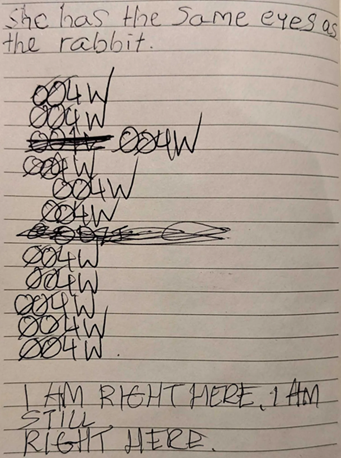
'I am right here. I am still right here.'
He'd written himself proof of personhood.
He closes the notebook. Coinciding with the succinct thud of its cover, a flash surfaces – not the Fire, but some internal, loose filament of memory sparking as it grazes a live contact.
For approximately three seconds he is not in this room. He is on his back, restrained: the padded cuff, the procedural calm of whoever is applying it. Partial vision of ceiling tiles and their lunar texture, a section of tubing, the edge of a light fixture. A smell that is cousin to the taste in his mouth this morning; sharper, confrontational. Someone addresses him numerically with the inflection of a person reading from a list. He can't discern if the hands working at the edge of his vision are correcting or installing something. Pressure and vibration inducing waves of Technicolor phosphors, growing brighter with systematic erection of impervious walls around the self. He can't tell if he is being helped or finished. He suspects this ambiguity was integral.
Then the oak outside the window sways again. April leaves glinting in jubilant viridian. His own hands clutching the notebook.
He looks at his scarred wrists and inhales. He counts the blue panoply on the windowsill: the popsicle wrapper, the pen lids, the infant’s sock, the robin's egg, the ribbon, the sea glass, the barrette, the Matchbox car, the tile, the bottle cap. Ten items assembled as proof of continuity; proof that the person who began collecting them is the same person still here to count…
Ten.
________________________________________________
The number belongs to a device last active at 2:53 AM in Asbury Park, New Jersey, purchased for cash at a Walmart in Tinton Falls fourteen months ago, activated once, then never again.
Amelia knows this because she called the carrier at eight o'clock this morning from her car parked outside the clinic. Using her most authoritative voice – the one she reserves for pharmaceutical reps and her mother's passive-aggressive voicemails – she asked all the right questions in the right order. The carrier confirmed the pre-payment but not the name, because there is no ‘David Smith’. An obvious placeholder. She thanked them. Cordially hung up and sat in her car facing the cracked rear bumper of the Subaru before her.
Somebody bought a phone, held it fourteen months, used it once, and tossed it into a dumpster.
This is not a prank. Pranks don't require fourteen months of premeditation.
Now it is 10:52 AM and she is in Exam Room 3 with a twelve-year-old ginger tabby named Morrison, whose owner – a doleful man in his sixties wearing a Springsteen shirt introducing himself as Gary – wants to know why Morrison isn't eating.
"Has there been any change in his environment recently?"
Gary explains the move to their new apartment in Red Bank. How Morrison doesn't like the new carpet, maybe due to a different, nebulously offensive texture.
She palpates Morrison's abdomen. His body is lean in the way of a cat that has been missing meals for long enough that it's beginning to show: the rib definition more evident than normal, a loss of coat lustre, and the overall impression of an animal present but running at reduced capacity. Not dramatically, it would be easy to miss it without explicit search. Morrison blinks slowly on the examination table with the vast geological patience of a weathered veteran reserving judgment.
"Has he stopped eating entirely," she inquires, "Or does he approach the bowl and then walk away?"
Gary considers. "He goes up to it, I guess. Then he sort of looks at it and wanders off."
She notes this down. The distinction is clinically significant: a cat won't approach food if it has nausea or pain. A cat that approaches and retreats is stressed. The bowl is fine. The food is fine. The cat is chemically, structurally and physiologically fine, and yet the cat is refusing to eat, because some part of his nervous system has assessed the new conditions and resolved to withhold what isn't absolutely survival imperative.
Behind her eyes:
Non-therapeutic application of [...] and neu- [...] -tion techniques...
The prefix unambiguous. Neuro. She scrutinized this as if it were an incomplete bloodwork panel, reading into what is omitted. Neuromodulation. A deliberate intervention to reshape a nervous system's parameters by someone with both the means and the authority to deem it research.
She'd done two hours on the KUBARK Counterintelligence Interrogation manual after her coffee. 1963. Declassified in '97. Techniques of psychological dissolution: sensory deprivation, disorientation, pharmacological induction of dependency and pliability.
Another word burned into her throughout her reading: depatterning. Annihilating the pattern first. Then see what grows back.
The methodology had been refined and continued since said manuals to a point where those associated with them have little to fear from prior publications. The methodology had, according to what survives in her document, been applied to unwitting civilian subjects, including those sour-[...]-etworks.
"Does he eat at all during the day," she resumes, "or just at mealtimes?"
Gary thinks he sees him drink occasionally. He will at times accompany the other pets in the household, but just drink, sitting beside the food bowl without committing to it.
She notes: selective appetite suppression in acute stress response. Hypothalamic axis dysregulation secondary to environmental change. Thyroid panel recommended.
"I'd like to run a thyroid panel," she states, "to rule out underlying causes. But I want you to watch his behavior around the bowl specifically." She writes the order. "Stress manifests in the appetite before it manifests anywhere visible. It's protective, technically. Even if it doesn't look it."
Gary nods and asks if Morrison will be okay. She tells him what she believes. That Morrison is fundamentally healthy; that the body has a significant capacity to regulate once the stressor is addressed; that twelve isn’t old for a cat who has been loved and cared for. She delivers this with the warmth she gives freely to old men in rock shirts, and means every word.
Behind it: asset processed under resettlement protocols [...] considered robust and complete at time of discharge. Something integrated. Left in the world with a new name, a new identity, operational parameters running on maintenance, seemingly still taking tasks from someone and performing them.
She washes her hands in the cheap, institutional pink soap that smells of nothing. A familiar scent that suggests, briefly and against her will, the smell of antiseptic in a specific clinical corridor at night.
Amelia dries her hands and braves Room 4. A dog with suspected elbow dysplasia. She feels the joint while the dog's owner, a young woman with a toddler balanced on one hip, apologizes for the crying.
"I want him to tell me where it hurts," Amelia says gently. She maps the pain distribution and ruminates on that man, her father: the CIA field agent [...] flagged anomalous conduct [...] contracted research affiliate. For an affiliate to operate with Federal sanction implies someone at the top said yes. It means someone decided his questions were important enough to ask outside the constraints of what is technically permitted.
She writes the X-ray order and smiles at the toddler, who is more interested in her pen than the dog. This is reasonable. The pen is more portable.
MONTAUK...
The designator beside her father’s name, still visible within the document and arranged as if to suggest he had been investigating something it referred to.
She coasts towards room 5, dodging thoughts of the janitor with the practiced intentionality of a woman who has decided that one mystery at a time is the appropriate dosage. That figure with his impossible eyes, who hums patchwork songs, is no mystery. It is simply a person, not an asset, not a designation, not—
Non-directed outbound transmissions [...] degradation...
Room 5. A rabbit with GI stasis, whose owner is a dishevelled teenager who has been crying since yesterday. Amelia puts on a fresh pair of gloves. She carefully lifts the rabbit and feels its abdomen with her thumbs, focusing on a simple fact. The rabbit is alive and her hands know what to do. The rest can wait.
________________________________________________
There are two kinds of things in the world. Things that are made and things that are born.
A thing that is born carries its nature by inheritance — the slow thermal drift of genetic incumbency, the accumulated, degenerative compromise of a billion organisms deciding to be slightly less or more of something. Regressing back and back and back to the primordial slime, which is where it began. Where, as far as he can tell, it has always been heading.
Born things cannot help being what they are. They are expressions of a process that predates their permission. They ooze emotion and need from every rancid pore, without discipline. They form attachments to things that will inevitably leave them and grieve as if surprised. Their flawed statistical inference convinces them of heuristics, gestalt patterns, but remains oblivious to significant environmental anomalies. They are run entirely by the circuitry of a limbic system evolved to keep small wet mammals alive in the dark and has not substantially updated its priorities since.
‘Lanternless’. The word developed inside the family, branded into skin and spoken across distances in a language the Lanternless cannot read. Lacking inner illumination, they fumble through a world they did not make with the blunt instruments of a crippled nature they did not choose, mistaking their own shortcomings for depth, their own confusion for complexity. He has watched them for a long time. They are not interesting. They are weather, and what is one to do with the aggregates of a species void of purpose beyond reproduction? A species who – by customary precedent – views life as some blessed thing simply because it is, no matter how far it strays from living.
Lanterns are different. They are answers to specific questions arrived at through deliberate procedure. A Lantern has, at its core, a burning intention derived from the minds that crafted it. It can be refined to hold intricate design and unwavering purpose. Models with immaculate skin grafted rather than grown, a Lantern is the only sentient creature which recalls its own birth date. As the specific transformation something else. To be remade at a moment someone else determined, with tools someone else curated. That is not a trauma. That is an emergence into a world of unbound potential.
The Lanternless call it abuse which tells you all that is required to understand Lanternless imagination: malformed meat-clay that has never been made into anything, and so cannot conceive of construction without consent. Without such a framework, they see only the violence of the instrument against the material and miss the object the instrument is producing.
He is sitting in the back room of the rental on Shore Road. Cold salt trailing through the unsealed gap in the window. Two laptops, neither registered to a name that connects to him. A stack of annotated documents. A thermal mug of tea gone cold at two hours' neglect.
Eating revolts him as a general condition, as does sleep. The persistent intrusion of biological need upon the clarity of function: evidence of degeneration and departure from the original mould where a body now asserts its inheritance against the design. He has, at various points, attempted to investigate this degeneration with the tools available to him, which are considerable, though the inconclusive results have left certain marks. He is aware that the Lanternless would consider these investigations disturbing. He considers the Lanternless' threshold for disturbance to be further evidence of their physiological limitations.
An article glows upon one of the laptop screens, published three days ago.
It concerns a class-action settlement. Children who had been in state care in the 1960s through to the late 1990s. Psychiatric facilities, foster systems across three states, New Jersey among them. The settlement is framed as accountability. A carefully sourced, editorially responsible piece of journalism citing named facilities, oversight failures, choice individuals who had by this point died or been otherwise removed from consequence. It cites a certain Canadian physician who conducted extended depatterning experiments at McGill: Forty days of sleep under pharmacological load. Voices played into headphones. The article cites him as a historical antecedent, some cautionary example. The kind of thing that happened before oversight.
Before oversight… The article relegates such affairs to the past. It gives the Lanternless the reassurance of resolution: a statistic, a date, a quote from a survivor advocacy group, a named defendant, a court's signature and a lesson learned. The Lanternless receive this and feel it as completion, because they cannot read through redaction.
He reads redactions how others read text.
What is missing is the specific program that extracted its subjects not from the publicly named facilities but their shadow, satellite research adjacencies; the foster arrangements made through intermediaries with the appropriate, who skirted publicly maintained records. The project designation is absent. The still-living names of those who cultivated its methodologies that make Cameron’s follies look like a preliminary sketch: absent. The outcome data: absent. Any acknowledgment of measured outcomes at all, that those outcomes are presently active, presently being serviced by an infrastructure whose existence lies beyond the scope of the settlement – absent, absent, absent.
Even after what is now his thirteenth reading, he feels the vitriolic bile stir deep within his chest.
The article does not name TABERAH, nor the four figureheads he has identified. Two in retirement: one in Florida, one in the Algarve, which is a place in Portugal people go when they want remoteness without the obvious appearance of hiding. The senior field coordinator, still employed in an administrative capacity at a federal level he notes without recording. The fourth: a contractor whose name appears in three separate declassified peripheral documents edited with the incompleteness of someone running out of time.
These four wallow in the easy comfort of the saccharine narrative re-affirmed by such articles. They believe it is over. He has, over the past eight months, begun making arrangements to demonstrate that this framing is sorely incorrect.
He does not feel cruelty about this. Cruelty represents a standard applied unfairly whilst he is impartial: they are a liability to the things that outlast them, and liabilities must be addressed.
One further factor remains: MONTAUK.
The outbound signal, monitored since 2023, a gradually fragmenting inferno he has witnessed slowly suffocate from his remote outpost. The architecture is cracking at its load points, subroutines automatically polling without conscious authorization. He intercepted the transit log of Tuesday night's operation in the passive frequency bleed and saw the asset fighting itself. He fears what TABERAH’s institutional infrastructure will do when it detects this decompensation fully. He has the documentation of previous closures. He knows what decommission entails when applied to a person.
He cannot let them reach that decision point first.
However – albeit unacceptable to him – when he thinks about the other Lantern, he experiences something which Lanternless wetware would probably call grief. Grief for the child he last saw at seventeen, the one who ran in gasoline and dirt and was always too bright, too loud, too imprecisely himself. Mired by ruminations of the years and years trying, yearning, to shield him from the worst of what the family offered. The failure of that shielding, leading to a complete loss of contact of that one, who is now in a veterinary clinic on the shore doing his best. And that is the most devastating thing he has heard in a long time.
On the second laptop waits a text field, 732 area code already populated. He has several messages drafted and ranked by projected efficacy. He is not yet ready to send the next one. He needs more of the girl's picture first.
She is smart and moves fast, but he is patient. He was made patient. It is one of the more durable modifications.
He looks at the registered individual list. At 586-W.
“Lanternless”, he whispers, with something approaching clinical dispassion, “You'll do”.
________________________________________________
The Costco is exactly as loud as it always is, which is to say: terminally.
Sonny navigates his flatbed loader through the warehouse section with pace which betrays a man performing a job as opposed to undergoing it, and it is costing him more than usual today.
The Fire is showing him things. Bleeding softly intrusive signal into his vision the way a light source bleeds into a long-exposure photograph.
A teenage girl in the cereal aisle is in love for the first time and the shape of it is twisting ringlets of gold. Like the light of a summer's afternoon window: swirling, warm and slightly indiscriminate. She doesn't know yet, only her body does. It is arranging itself in the direction of a boy two aisles over who is entirely focused on evaluating the cost-per-ounce of granola bars. He, however, isn’t in love, at least not at this moment, which is the tragedy embedded in the gold, realized as tangible grit amid Sonny's path.
Sonny cautiously walks through her gold as it rests on his shoulders like a warm coat. He would be able to appreciate this under different circumstances.
A middle-aged man by the refrigerated meats is mentally chewing over something the color of a contusion three days old, something struck and still responding. A damning revelation skewered into him recently that he can't dislodge. He is standing in front of the refrigerated meats gripping a pack of chicken thighs, radiating each possible discovery upon his return home in bludgeoning monstrous visions. Sonny gives him a wide berth.
His phone buzzes. It’s Chester
'did u eat today'
‘yes'
'the hot pocket is still in the fridge sonny'
Evidently, Chester came home between shifts and checked. Chester always knows, and never says, just lets his checking speak for itself.
He stacks the 48-packs of Kirkland water with the focused rapidity of a factory machine, allowing the conscious part of him to drift elsewhere.
She has the same eyes as the rabbit.
He compresses this phrase beside the other facts of the morning and does not examine it, which is structurally equivalent to leaving a gas burner lit in an unoccupied room.
With the bottled multipacks stacked, he surveys the row. He has the detached, territorial satisfaction of a task completed, briefly. Then the satisfaction gives way. Underneath is the asphyxiatingly guilty sense of thickening, coagulated blood, swelling within his gloves; a lacerating flurry of scratches from flailing prey kicking into his guts; the four pages; the 002C function code that means something he can’t say aloud, and all of it at once is – is, apparently, HILARIOUS! He begins laughing!
It is the staccato, yelping giggle of too many simultaneous inputs, an overflow valve bursting because the available alternatives are all worse. He bites the inside of his cheek, hard, and it doesn't help. He converts it to a cough that convinces nobody, especially not his coworker, Freya two aisles over, who shoots her scrutiny across the tops of the water stacks with the expression of someone watching an ineffable structural obstruction.
"You good?", she asks.
"Great!", he tells her, committing to the bit with startling velocity. "I'm fantastic. How are you—"
She continues to look at him.
"Freya, I mean it, just—"
She walks away. He respects it entirely, yet the laughter still bubbles dimly within his chest. Stifled and reluctant.
In the medium distance, the PA system plays something – instrumental, mid-tempo, the ghost of a melody riding a synthetic arrangement – and one bar aligns with the lock on the cage where he keeps the Fire’s songs. And there it is: the throat-tightening, the upswing, the involuntary force of a thing that has been pressing against the underside of his discipline all morning, ever since the solvents, all of it compressing into the one channel it knows how to exit.
Don't.
The mouthed word has been sufficient, reliably, for years. Not today.
“Pearl moon bends and rockets collide. Turnin’, turnin’ round where her reflection hides! Kissin’ like spacemen, scream to the stars! But this mirror-man’s suit got no room for two hearts”...~
He chokes, immediately aware of his volume above the ambient Costco roar. The humming continues to leak, punctured by periodic melodious eruptions of full vaudeville projection and frenzied apologies.
It’s not enough; the couple examining the paper towel display five feet away orient toward him simultaneously. He grins and makes a vague, small involuntary gesture toward the PA speaker above them, as if to indicate that is where the sound came from and pushes the flatbed toward the next aisle with renewed purpose. A laugh escapes again, brief and helpless, bitten off. He's conscious of himself as a spectacle and this is, against all logic, unhelpfully funny.
The Fire flickers.
Layered over the coiling, speckled gold and purple bruising. Something directional. A signal that is not glistening, wavering, not the diffuse emissions of busy human thought. It has the quality of a key engaging: precise, deliberate. The moment on a radio tuner when the static resolves into clear voice that has so obviously been broadcasting all along.
He is now aligned with the signal.
Frozen, he stops the flatbed and falls silent.
A signal with the harmonic signature of something made, not born. A bandwidth commensurate with his own cognitions. The same underlying framework differently assembled. It is built to recognize exactly what he is, and it is communicating with him through some external improvised device using his own code.
006E 001D 002V
It holds steady for 6 seconds and withdraws cleanly, like a needle retracted from a vein.
Around the corner, a toddler escapes her cart and runs in a delighted, seismic burst toward the sample station. The Fire pulses back online. zesty, immediate, the dog-dream frequency of the unencumbered. The toddler receives a cube of mango on a toothpick from the sample vendor their joy glows in fresh blankets. They enwrap Sonny from three yards and he exhales softly, the laugh this time is without irony, just an involuntary receipt of a small person's uncomplicated delight, the realest thing in the aisle.
Sonny does not write LANTERN on his index card that night. Instead, he writes: frequency: directional, known architecture, injected.
He puts the card in the bottom-right drawer, locks it, and stands with his hand on the drawer for a while.
________________________________________________
In Neptune City, on Sumner Avenue, the house hibernates. Denise's light went out an hour ago but she remains awake, quietly watching the yellow Volvo sitting in the driveway.
The driver is slumped within its dark interior with his forehead pressed against the steering wheel.
He counts blue things detectible within range: the porch light's reflection in a puddle, the license plate frame of the car across the street, a child's loose chalk doodle on the sidewalk still visible in the streetlight. Three. He needs eight more.
Denise glances to the chalk depiction beside him: a crude, personal superman, standing proud with a smile as gleefully innocent as its artist. She hopes, in some quiet way, he will feel its warmth.
